Home Research Teaching Service

Publications and preprints

  1. Universal circles for Anosov foliations. With Samuel Taylor. PDF.

    Abstract: Thurston introduced the notion of a universal circle associated to a taut foliation of a 3-manifold as a way of organizing the ideal circle boundaries of its leaves into a single circle action. Calegari–Dunfield proved that every taut foliation of an atoroidal 3-manifold M has a universal circle, but the uniqueness (or lack-thereof) of this structure remains rather mysterious.

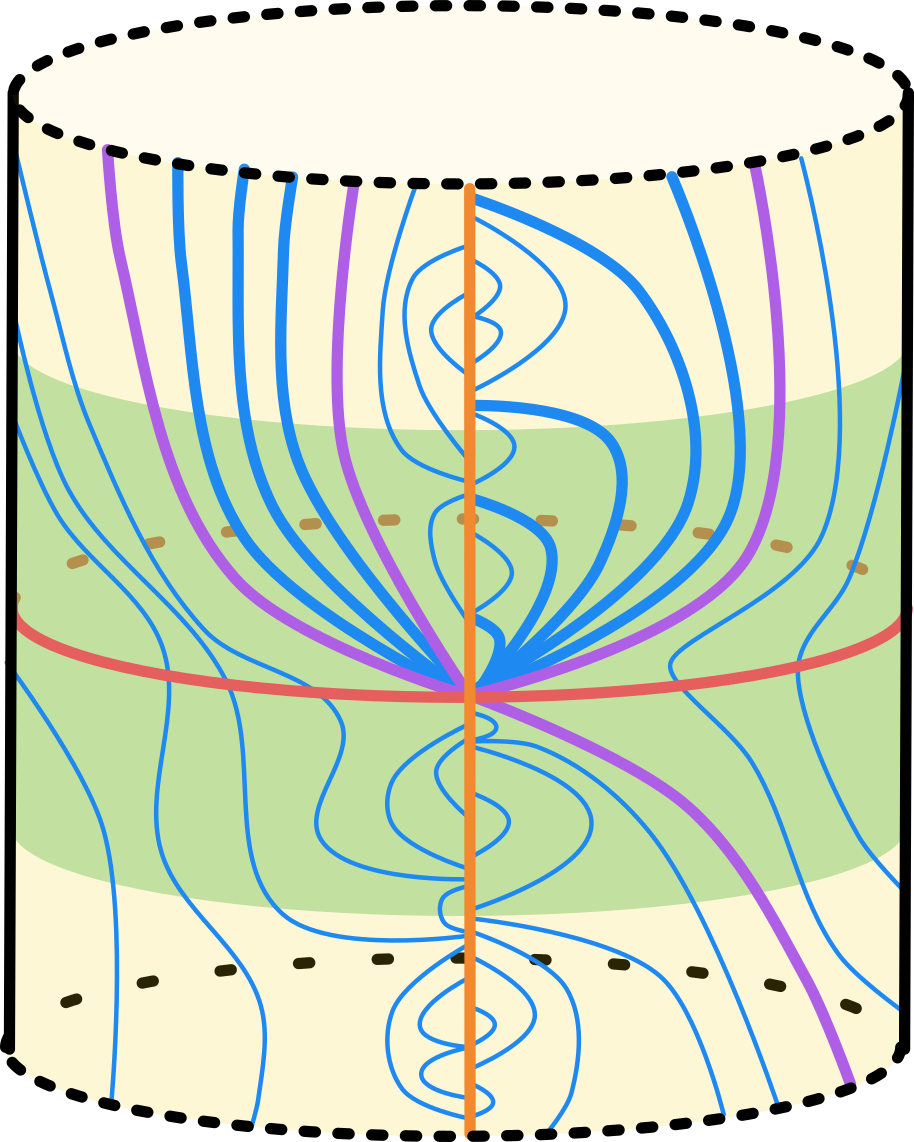
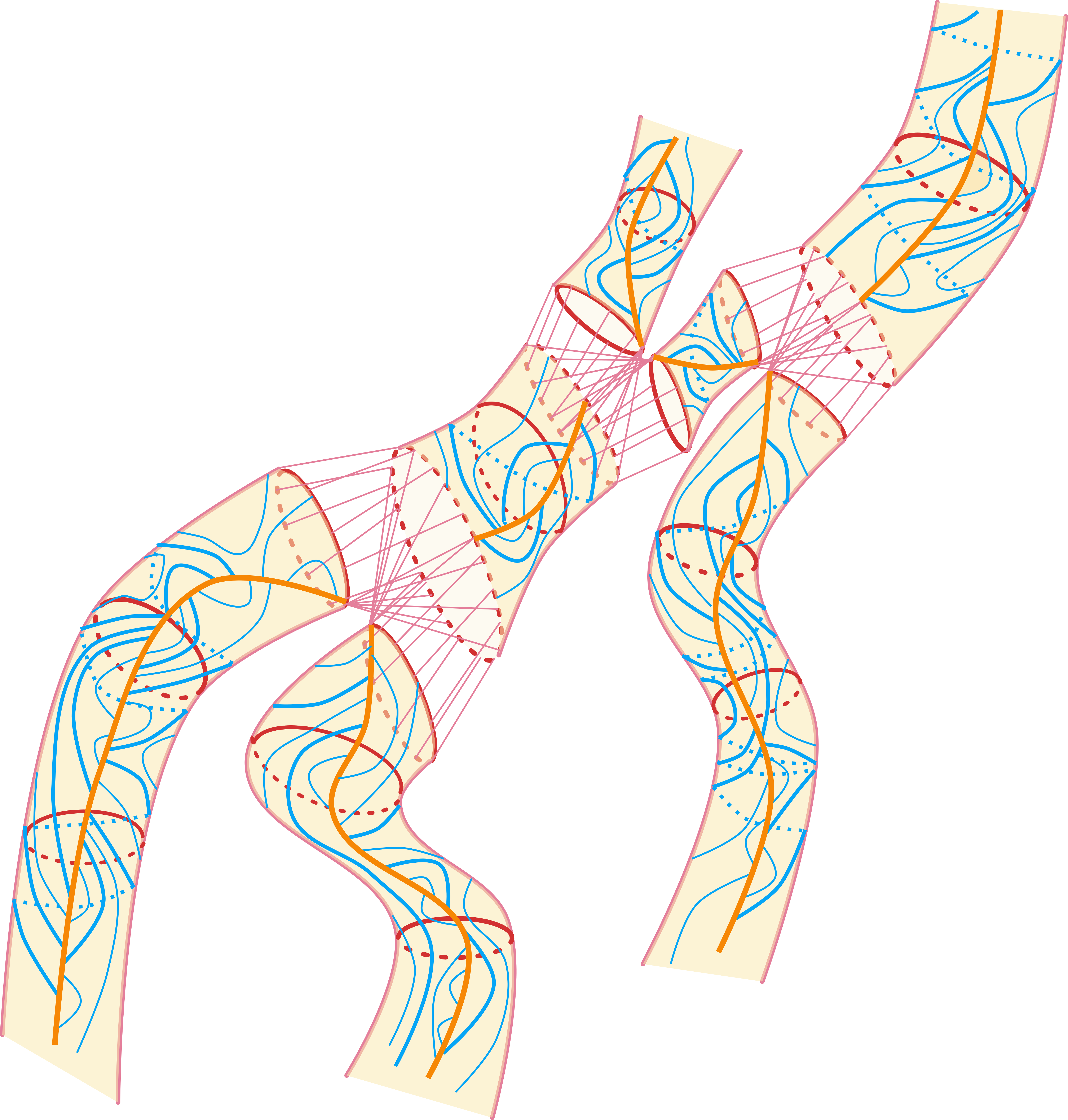
    In this paper, we consider the foliations associated to an Anosov flow ϕ on M, showing that several constructions of a universal circle in the literature are typically distinct. Moreover, the underlying action of the Calegari–Dunfield leftmost universal circle is generally not even conjugate to the universal circle arising from the boundary of the flow space of ϕ. Our primary tool is a way to use the flow space of ϕ to parameterize the circle bundle at infinity of ϕ’s invariant foliations.

  1. Periodic points of endperiodic maps. PDF. ArXiv link. Groups Geom. Dyn. (2025), published online first.

    Abstract: Let g : LL be an atoroidal, endperiodic map on an infinite type surface L with no boundary and finitely many ends, each of which is accumulated by genus. By work of Landry, Minsky, and Taylor, g is isotopic to a spun pseudo-Anosov map f. We show that spun pseudo-Anosov maps minimize the number of periodic points of period n for sufficiently high n over all maps in their homotopy class, strengthening a theorem of Landry, Minsky, and Taylor. We also show that the same theorem holds for atoroidal Handel--Miller maps when one only considers periodic points that lie in the intersection of the stable and unstable laminations. Furthermore, we show via example that spun-pseudo Anosov and Handel--Miller maps do not always minimize the number of periodic points of low period.

Recorded talks

  1. Periodic points of endperiodic maps at the CMO, available here.

Work from undergraduate

  1. Domains of Convergence for Polyhedral Packings. With Nooria Ahmed, William Ball, Emilie Rivkin, Dylan Torrance, Jake Viscusi, Runze Wang, Ian Whitehead, and S. Yang. ArXiv link.

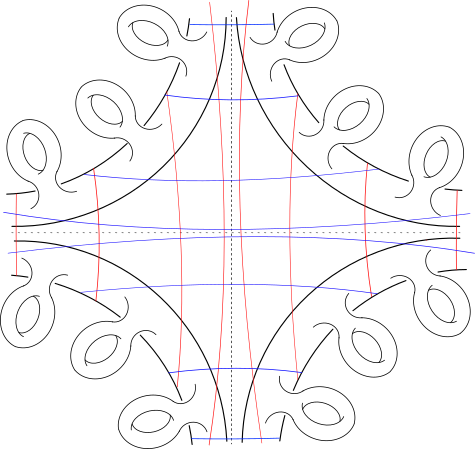
    Abstract: Polyhedral circle packings are generalizations of the Apollonian packing. We develop the theory of the Apollonian group, Descartes quadratic form, and related objects for all polyhedral packings. We use these tools to determine the domain of absolute convergence of a generating function that can be associated to any polyhedral packing. This domain of convergence is the Tits cone for an infinite root system.

  2. Appendix to Littlewood--Richardson rules from quivers for two-step flag varieties. With Linda Chen and Elana Kalashnikov. ArXiv link.

    Abstract: Let ⋀1 and ⋀2 be two symmetric function algebras in independent sets of variables. We define vector space bases of ⋀1⊗Z⋀2 coming from certain quivers, with vertex sets indexed by pairs of partitions. We use these vector space bases to give a positive tableau formula for Littlewood--Richardson coefficients for the product of Schubert polynomials with certain Schur polynomials in two-step flag varieties, in the spirit of the Remmel-Whitney rule for the product of two Schur polynomials in Grassmannians. This in particular covers the cases considered by the Pieri rule.